AI, Machine Learning & Data ScienceOreilly2021-12 Edition100% Free Video Course

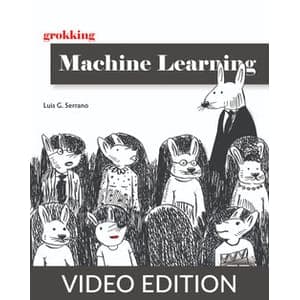
Grokking Machine Learning, video edition

Grokking Machine Learning, video edition, In Video Editions the narrator reads the book while the content, figures, code listings, diagrams, and text appear on the screen. Like an audiobook that you can also watch as a video. Discover valuable machine learning techniques you can understand and apply using just high-school math. Grokking Machine Learning teaches you how to apply ML to your projects using only standard Python code and high school-level math. No specialist knowledge is required to tackle the hands-on exercises using Python and readily available machine learning tools. Packed with easy-to-follow Python-based exercises and mini-projects, this book sets you on the path to becoming a machine learning expert.Discover powerful machine learning techniques you can understand and apply using only high school math! Put simply, machine learning is a set of techniques for data analysis based on algorithms that deliver better results as you give them more data. ML powers many cutting-edge technologies, such as recommendation systems, facial recognition software, smart speakers, and even self-driving cars. This unique book introduces the core concepts of machine learning, using relatable examples, engaging exercises, and crisp illustrations. This course skips the confused academic jargon and offers clear explanations that require only basic algebra. As you go, you’ll build interesting projects with Python, including models for spam detection and image recognition. You’ll also pick up practical skills for cleaning and preparing data.
5.0
(1 reviews)
16.3 Hours On-Demand
Created by Senior Industry Specialist
Uploaded Sep 2026
English
Grokking Machine Learning, video edition
Preview This Course
Free$129.99100% Free

Instant high-definition streaming with zero paywalls.

Course Features:
16.3 hours on-demand video
95 complete lectures
1 downloadable project zip file(s)
Streamable on mobile, tablet & desktop
Self-paced curriculum with progress tracking
Direct MP4 downloads & offline video access
Verified course archives hosted on cloud infrastructure.

What You'll Master in this Course

Master practical concepts and hands-on skills in AI, Machine Learning & Data Science
Complete 95 video lectures with real-world examples and workflows
Build confidence with step-by-step instructions from industry experts
Access downloadable course resources and exercise files

Course Curriculum95 Lectures

1 sections • 16.3 hours total length

Prefer offline learning? Download all 95 video lectures and project files for free.
Download Free
Chapter 1. Some examples of models that humans use
Preview
7m
Chapter 1. What is machine learning
Preview
11m
Chapter 1. What is machine learning It is common sense, except done by a computer
15m
Chapter 1. What is machine learning It is common sense, except done by a computer
15m
Chapter 1. Example 4 More
6m
Chapter 2. Types of machine learning
10m
Chapter 2. Supervised learning The branch of machine learning that works with labeled data
14m
Chapter 2. Unsupervised learning The branch of machine learning that works with unlabeled data
10m
Chapter 2. Dimensionality reduction simplifies data without losing too much information
11m
Chapter 3. Drawing a line close to our points Linear regression
9m
Chapter 3. The remember step Looking at the prices of existing houses
11m
Chapter 3. The linear regression algorithm Repeating the absolute or square trick many times to move the line closer to the points
9m
Chapter 3. Some questions that arise and some quick answers
8m
Chapter 3. Crash course on slope and y-intercept
10m
Chapter 2. What is reinforcement learning
8m
Chapter 3. How do we measure our results The error function
10m
Chapter 3. Simple trick
10m
Chapter 3. Gradient descent How to decrease an error function by slowly descending from a mountain
13m
Chapter 3. Parameters and hyperparameters
10m
Chapter 4. Another example of overfitting Movie recommendations
11m
Chapter 4. How do we get the computer to pick the right model By testing
14m
Chapter 3. Real-life application Using Turi Create to predict housing prices in India
11m
Chapter 4. Optimizing the training process Underfitting, overfitting, testing, and regularization
16m
Chapter 4. An intuitive way to see regularization
6m
Chapter 4. A numerical way to decide how complex our model should be The model complexity graph
12m
Chapter 4. Modifying the error function to solve our problem Lasso regression and ridge regression
12m
Chapter 5. Sentiment analysis classifier
10m
Chapter 5. Using lines to split our points The perceptron algorithm
14m
Chapter 4. Polynomial regression, testing, and regularization with Turi Create The testing RMSE for the models follow
9m
Chapter 4. Polynomial regression, testing, and regularization with Turi Create
7m
Chapter 5. The problem We are on an alien planet, and we don t know their language!
11m
Chapter 5. The step function and activation functions A condensed way to get predictions
10m
Chapter 5. Error function 3 Score
9m
Chapter 5. Pseudocode for the perceptron trick (geometric)
10m
Chapter 5. The bias, the y-intercept, and the inherent mood of a quiet alien
12m
Chapter 5. Pseudocode for the perceptron algorithm
13m
Chapter 6. A continuous approach to splitting points Logistic classifiers
14m
Chapter 5. Bad classifier
10m
Chapter 5. Coding the perceptron algorithm using Turi Create
12m
Chapter 6. Error function 3 log loss
11m
Chapter 6. Formula for the log loss
14m
Chapter 6. Pseudocode for the logistic trick
9m
Chapter 6. The dataset and the predictions
7m
Chapter 7. How do you measure classification models Accuracy and its friends
12m
Chapter 6. Classifying into multiple classes The softmax function
10m
Chapter 6. Coding the logistic regression algorithm
10m
Chapter 7. False positives and false negatives Which one is worse
13m
Chapter 7. A useful tool to evaluate our model The receiver operating characteristic (ROC) curve
7m
Chapter 7. Recall Among the positive examples, how many did we correctly classify
13m
Chapter 7. Recall is sensitivity, but precision and specificity are different
7m
Chapter 7. The receiver operating characteristic (ROC) curve A way to optimize sensitivity and specificity in a model
9m
Chapter 7. Summary
8m
Chapter 8. Using probability to its maximum The naive Bayes model
10m
Chapter 7. Combining recall and precision as a way to optimize both The F-score
12m
Chapter 7. A metric that tells us how good our model is The AUC (area under the curve)
9m
Chapter 8. Sick or healthy A story with Bayes theorem as the hero Let s calculate this probability
8m
Chapter 8. Prelude to Bayes theorem The prior, the event, and the posterior
10m
Chapter 8. What the math just happened Turning ratios into probabilities
9m
Chapter 8. What the math just happened Turning ratios into probabilitiesProduct rule of probabilities
4m
Chapter 8. What about more than two words
6m
Chapter 8. Implementing the naive Bayes algorithm
8m
Chapter 8. What about two words The naive Bayes algorithm
15m
Chapter 9. Splitting data by asking questions Decision trees
10m
Chapter 9. Gini impurity index How diverse is my dataset
6m
Chapter 9. The graphical boundary of decision trees
8m
Chapter 10. Combining building blocks to gain more power Neural networks
12m
Chapter 10. Potential problems From overfitting to vanishing gradients
13m
Chapter 10. Training the model
10m
Chapter 9. Classes of different sizes No problem We can take weighted averages
12m
Chapter 9. Applications
8m
Chapter 10. Neural networks with more than one output The softmax function
10m
Chapter 10. The boundary of a neural network
12m
Chapter 9. Beyond questions like yesno
8m
Chapter 10. Other architectures for more complex datasets
9m
Chapter 10. How neural networks paint paintings Generative adversarial networks (GAN)
11m
Chapter 11. Distance error function Trying to separate our two lines as far apart as possible
10m
Chapter 10. Why two lines Is happiness not linear
11m
Chapter 11. Finding boundaries with style Support vector machines and the kernel method
11m
Chapter 11. Training SVMs with nonlinear boundaries The kernel method
11m
Chapter 11. Overfitting and underfitting with the RBF kernel The gamma parameter
10m
Chapter 11. Going beyond quadratic equations The polynomial kernel
13m
Chapter 11. A measure of how close points are Similarity
11m
Chapter 12. Combining the weak learners into a strong learner
10m
Chapter 12. Gradient boosting Using decision trees to build strong learners
10m
Chapter 12. Fitting a random forest manually
10m
Chapter 12. XGBoost similarity score A new and effective way to measure similarity in a set
7m
Chapter 12. Combining models to maximize results Ensemble learning
12m
Chapter 12. Building the weak learners Split at 25
6m
Chapter 13. Putting it all in practice A real-life example of data engineering and machine learning
13m
Chapter 12. Tree pruning A way to reduce overfitting by simplifying the weak learners
11m
Chapter 13. Turning categorical data into numerical data One-hot encoding
13m
Chapter 13. Using Pandas to study our dataset
10m
Chapter 13. Testing each model s accuracy
9m
Chapter 13. Feature selection Getting rid of unnecessary features
11m
Chapter 13. Tuning the hyperparameters to find the best model Grid search
9m

Requirements

  • No machine learning knowledge necessary, but basic Python required.

Description

Grokking Machine Learning, video edition, In Video Editions the narrator reads the book while the content, figures, code listings, diagrams, and text appear on the screen. Like an audiobook that you can also watch as a video. Discover valuable machine learning techniques you can understand and apply using just high-school math. Grokking Machine Learning teaches you how to apply ML to your projects using only standard Python code and high school-level math. No specialist knowledge is required to tackle the hands-on exercises using Python and readily available machine learning tools. Packed with easy-to-follow Python-based exercises and mini-projects, this book sets you on the path to becoming a machine learning expert.Discover powerful machine learning techniques you can understand and apply using only high school math! Put simply, machine learning is a set of techniques for data analysis based on algorithms that deliver better results as you give them more data. ML powers many cutting-edge technologies, such as recommendation systems, facial recognition software, smart speakers, and even self-driving cars. This unique book introduces the core concepts of machine learning, using relatable examples, engaging exercises, and crisp illustrations. This course skips the confused academic jargon and offers clear explanations that require only basic algebra. As you go, you’ll build interesting projects with Python, including models for spam detection and image recognition. You’ll also pick up practical skills for cleaning and preparing data.

Instructor

S

Senior Industry Specialist

Specialist in AI, Machine Learning & Data Science

Passionate educator focused on real-world practical skills, modern frameworks, and production-ready engineering practices. Delivering step-by-step masterclasses accessible to learners globally on MJ Accedemy.

Recommended Curriculum

Students Also Viewed